The use of DNA findings in furthering our family history is the reason this Study has been created. There are different approaches in utilizing DNA data that have emerged over the past few years. This Study is based on the premise that furthering family history is THE OBJECTIVE of our research and DNA findings are to serve us as a support in accomplishing this.
Approaches. There are many seeking and performing DNA testing, who are not familiar with the practice and type of expertise required in researching family history. While doing little or no genealogy or family history, such persons assume that testing may help them find a match to explain their ancestry. In such cases, IF a match is found, the persons involved then engage in trying to find the reason for their relationship. Tracing the family history to figure out “why a specific match occurred” becomes the primary objective in many such cases. From our perspective, this is very much like having one’s cart before their horse. It is also not family history as we know and practice it. There are clearly unique cases where this “jump in the pool” approach may be the only alternative for learning about one’s past as in adoptions, name changes, etc. Our view in applying DNA test findings is one from that of the perspective of family historians involved in an advanced research project in which the substantiation of a lineage, as one’s own, relies on the best documented resources available in light of a myriad of contextual factors unique to each family being traced. It should not be surprising that what matters to us, how we approach the defining of relationships, and our view of utilizing DNA data will sometimes not be compatible with or respected by those advocating a strong scientific and somewhat absolute view regarding the interpretation and application of DNA findings. This is a new field in an evolving context that our Study is contributing to by its very design. Hopefully, the melding of our family history research project and our DNA Study will offer a unique framework with a better understanding and appreciation for family history and the potential for applying DNA Findings to an advanced research project as our own, as well as to the field of family history generally.
Expertise Required. Another consideration is how expert one feels they want or need to be to be able to apply DNA findings to their family history. Our approach is to be expert in family history and rely on the expertise of professionals to consult us in the interpretation of DNA test findings and their application to our family history knowledge. Over time we will become more expert at this integration and become less reliant in some aspects of the application of DNA data (such as the basic comparison of data that can be clearly interpreted as related to a specific lineage), but there are some scientific applications we view as best to rely more fully on professionals in this field (such as unusual or distinct data or mutations). There are many people who are utilizing DNA testing and then pursuing the interpretation of the DNA as an end in and of itself. This is typically evident by the absence of family history and the preponderance of DNA data presented. This is not the intention of the design and application of DNA in our Study. For us, DNA is a means, not an end in and of itself. The interpretation of DNA data can be fun and is definitely interesting. There are many wonderful things to learn from DNA tests, even distant origins back to the Celts or Saxons, etc. However, DNA data can become very absorbing to the point it can take away from, not add to our primary objective. For this reason, we will work in this project to maintain a balanced view of DNA findings in light of our PRIMARY OBJECTIVE of furthering our family history.
Defining Our Ancestry. Our DNA STUDY has been designed to integrate DNA findings so interpretation of data can be considered in light of our knowledge of our family history. The pivotal tool is not the DNA, but the lineages from which we are assessing the relationships. This Study has different mechanisms to integrate this data in studying lineages - Lineage Studies including oral history and a Virtual Archive of Lineage “Snapshots” all linked with our vast resources in our family history project. The DNA results will be applied to these lineages and the knowledge we have of our family history in determining the relatedness among the many COMBS-COOMBS &c. branches that have been and will be established. The better we have documented and studied our family history, the more meaningful the DNA Findings will be. Of course, there will be drawbacks, and we will deal with these and learn more about the assumptions we have relied on in tracing our families. The longer we are involved in tracing our ancestry, the more we appreciate new resources and the possibilities they can provide us in furthering our family history. The application of DNA findings gives us such a resource.
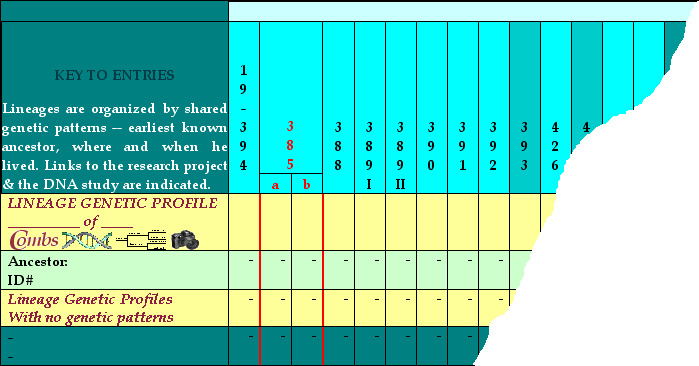
DNA Results. After researchers are tested and submit their test kits, there will be DNA data posted at a secure page of our website. The information available to persons tested will include numerical values representing up to 43 alleles that are measurements from markers found on the chromosome. These markers represent the identity unique to a specific person we have termed a “genetic profile” and, as similar profiles among researchers emerge we will have explicated the unique identity of a lineage we have termed a “lineage genetic profile”. These learnings will be conveyed to all list members in terms of findings. The DNA results will appear on a chart like the one below. The sample will help you see the nature of the data and how it is presented. There is minimal to no interpretation aside from grouping of the results into “lineage genetic profiles” where possible. The findings from this data will be fully discussed where all list members can appreciate the implications for furthering their family history.
Interpreting DNA Results into Findings. Once DNA test results are charted, they will be compared to determine relatedness of the persons tested. The lineages of the persons tested will be compared and relatedness will be defined to the extent possible. This will involve assessing the
This will be reviewed, discussed among members of our research group, and described in the LINEAGE STUDIES, noted on the Lineage “snapshot” in the VIRTUAL ARCHIVE., and generally addressed here. If it impacts the family history research project, it will be so noted in the most relevant report(s). Announcements that may affect researchers who may be related to a lineage tested will be posted to the list and to the Introduction section of our Study.
Please direct any questions to the Project Administrator who will do her best to respond to questions. Unless the responses are of a private nature, the Project Administrator will share responses that can benefit the research group as a whole.